
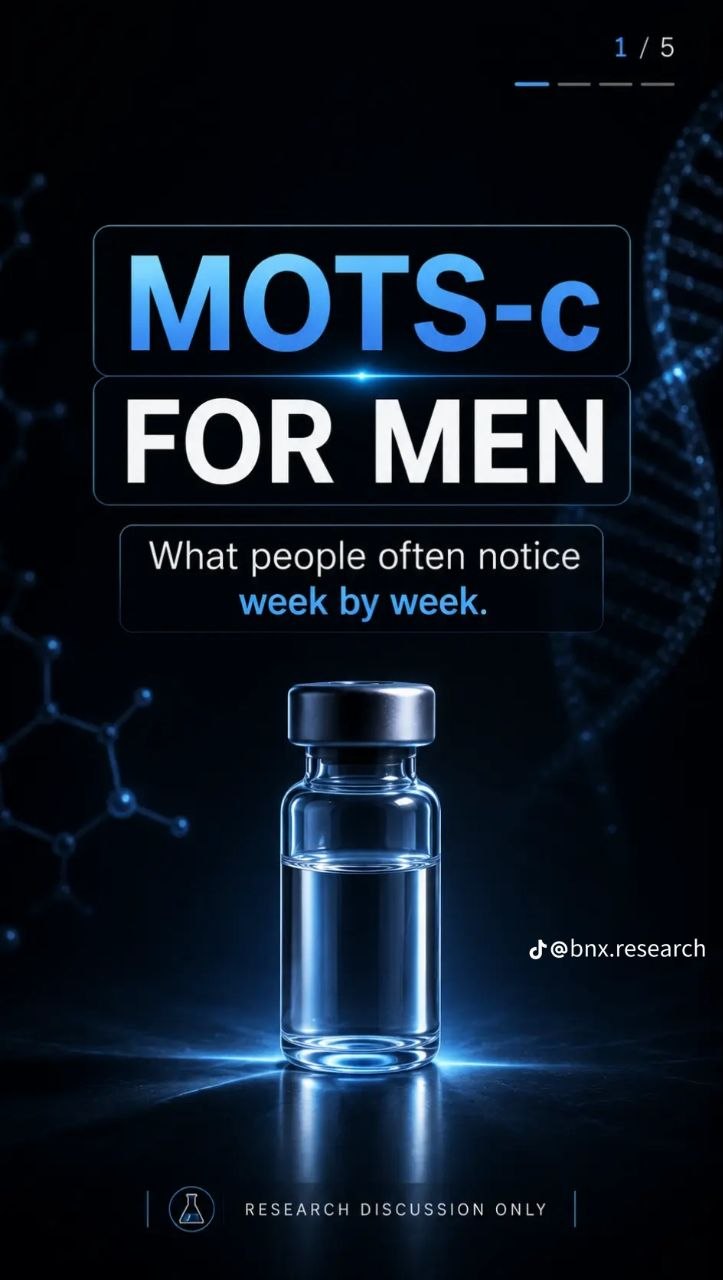
MOTS-c Peptide: The Mitochondrial Molecule Everyone Is Talking About
Buy MOTS-C online safely. MOTS-c is having a moment. But the science deserves more attention than the marketing.
Walk into the world of “performance peptides” and you’ll hear some pretty aggressive claims: better metabolism, improved insulin sensitivity, enhanced exercise performance, longevity, fat loss, mitochondrial optimization the list keeps growing.
MOTS-c sits right in the middle of that conversation.
And here’s the important part:
MOTS-c is genuinely fascinating. But fascinating biology is not the same thing as a proven therapy.
What exactly is MOTS-c?
MOTS-c stands for Mitochondrial Open Reading Frame of the 12S rRNA type-c.
Unlike many familiar peptides that are encoded by nuclear DNA, MOTS-c is encoded within the mitochondrial genome. It belongs to a relatively new class of molecules called mitochondria-derived peptides (MDPs).
Think of mitochondria as more than cellular “power plants.” They are also signaling hubs that respond to nutrient availability, cellular stress and changes in energy demand.
MOTS-c appears to participate in that communication network.
Research has linked MOTS-c with pathways involved in metabolic regulation, including AMP-activated protein kinase (AMPK), antioxidant responses and cellular stress adaptation.
That is where things get interesting.
The metabolic angle
AMPK is sometimes described as a cellular energy sensor.
When cellular energy availability changes, AMPK helps coordinate how cells use and conserve energy. Because metabolic dysfunction, insulin resistance and mitochondrial dysfunction are interconnected, researchers have been investigating whether MOTS-c could influence these processes.
Animal and cellular studies have produced intriguing findings involving glucose metabolism, mitochondrial function, oxidative stress and metabolic adaptation.
But here’s where peptide marketing frequently jumps the rails:
A mechanism is not a clinical outcome.
Showing that a molecule activates a pathway in cells does not automatically demonstrate that injecting that molecule into humans will produce meaningful weight loss, increased muscle mass, longer life or improved athletic performance.
Those are separate scientific questions.
Exercise makes the story even more interesting
MOTS-c has also attracted attention because mitochondria constantly respond to physical stress.
Exercise changes cellular energy demands dramatically. That means molecules involved in mitochondrial signaling are obvious candidates for investigation.
The hypothesis is compelling: perhaps MOTS-c is part of the body’s natural system for adapting to metabolic stress.
But “potentially involved in exercise adaptation” should not be translated into:
“MOTS-c is a performance-enhancing drug.”
Those statements are worlds apart.
And then comes the longevity hype
This is where you should put the brakes on.
MOTS-c has been investigated in the context of aging, metabolic dysfunction and cellular stress. Researchers are interested in whether mitochondrial-derived peptides might eventually become therapeutic targets for age-associated diseases.
That is legitimate science.
But there is currently nowhere near enough human evidence to conclude that MOTS-c extends human lifespan.
In fact, the regulatory picture is a major reality check.
As of 2026, the FDA says there is a lack of clinical and nonclinical safety information for MOTS-c-related bulk drug substances and specifically notes a lack of human data on drug products containing MOTS-c administered by any route. The agency also highlights unanswered questions around immunogenicity and peptide-related risks.
That’s not a minor footnote.
That’s the headline.
“But researchers have already studied MOTS-c in humans…”
Careful.
There are human studies measuring naturally occurring MOTS-c in people. For example, researchers have examined circulating MOTS-c in metabolic and cardiovascular contexts.
But measuring a molecule naturally produced by the body is not equivalent to administering pharmaceutical-grade synthetic MOTS-c and demonstrating that the treatment is safe and effective.
That’s a critical distinction.
You cannot take an observational association and turn it into a treatment recommendation.
The science isn’t even uniformly positive
This is another reason to ignore simplistic “mitochondrial optimization” narratives.
A 2026 study involving human mesenchymal stromal cells found that exogenous MOTS-c activated metabolic signaling but also produced effects including reduced proliferation, increased senescence-associated markers and increased TNF-α in the experimental system. In an accompanying mouse model, MOTS-c pretreatment did not improve the tested reparative outcomes.
That doesn’t prove MOTS-c is harmful in humans.
It does something more scientifically useful:
It demonstrates that biological effects can be context-dependent.
A molecule that looks beneficial in one metabolic pathway or disease model can produce different effects in another biological environment.
Biology doesn’t care about your supplement stack.
So what is MOTS-c actually good for?
Right now, the strongest answer is:
Research.
MOTS-c is a legitimate and scientifically interesting mitochondrial-derived peptide with potential relevance to metabolism, cellular stress responses, inflammation and mitochondrial biology.
Researchers are actively investigating those possibilities.
But calling it a proven anti-aging drug, fat-loss peptide, muscle-building compound or human performance enhancer goes substantially beyond the evidence.
The peptide industry’s biggest problem
The problem isn’t that MOTS-c is nonsense.
The problem is that the real science is already interesting enough without exaggerating it.
There is no need to turn preliminary biology into a miracle story.
MOTS-c doesn’t need a superhero origin story.
It has one already:
A small peptide encoded by mitochondrial DNA that may help cells communicate with metabolic and environmental stress.
That’s legitimately cool.
But the distance between “interesting molecule” and “safe, effective human therapy” is enormous.
That distance requires pharmacokinetics.
It requires toxicology.
It requires properly controlled human trials.
It requires reproducible manufacturing.
It requires dose-finding.
It requires long-term safety data.
And eventually, it requires clinical outcomes that matter to patients—not just impressive molecular pathways.
The bottom line
MOTS-c deserves attention.
But it deserves scientific attention, not blind hype.
The research suggests that this mitochondrial-derived peptide may influence important metabolic and stress-response pathways. Preclinical findings are intriguing, and newer research continues to uncover surprising biological functions.
At the same time, the human therapeutic evidence remains limited, and the FDA’s 2026 assessment highlights major unanswered safety questions surrounding drug products containing MOTS-c.
So if someone tells you MOTS-c is the next miracle longevity peptide, ask for the human clinical data.
If they tell you it’s completely useless, ask them to explain the rapidly expanding mitochondrial-peptide literature.
The intellectually honest position is considerably less exciting—and considerably more useful:
MOTS-c is promising research biology. It is not yet proven medicine.
And until the human evidence catches up with the hype, that’s exactly where it belongs.
I can also turn this into a more provocative fitness/biohacking version, a scientific journal-style article, or an SEO-optimized 2,000-word blog post with citations and FAQs.




Reviews
There are no reviews yet.